Commercial Property Security: 10 Proven Ways to Reduce Theft & Protect Your Property
Effective commercial property security requires more than installing a few cameras or locking the doors at night. Property owners and managers need a layered strategy designed to deter criminal activity, control access, identify threats, and respond quickly when suspicious activity occurs.
Whether you manage an office building, retail center, mixed-use development, industrial property, parking facility, or multi-building portfolio, the right security strategy can help reduce theft, vandalism, trespassing, and liability while creating a safer environment.
Here are 10 proven ways to strengthen security at a commercial property.
Why Is Commercial Property Security Important?
Commercial properties can be attractive targets because they often contain valuable equipment, vehicles, electronics, inventory, and other assets. Many also have large parking areas, multiple entrances, limited overnight staffing, or areas that are difficult to monitor.
Common security risks include:
- Theft and burglary
- Vehicle break-ins
- Vandalism
- Trespassing and loitering
- Unauthorized building access
- Employee or tenant security concerns
- After-hours activity
- Package and delivery theft
- Damage to equipment or property
A single security incident can result in more than the immediate cost of stolen or damaged property. Businesses may also face operational disruptions, insurance claims, repairs, lost productivity, and concerns from tenants or employees.
A well-designed security plan focuses on both prevention and response.
10 Proven Ways to Improve Commercial Property Security
1. Conduct a Professional Security Assessment
Every property has different vulnerabilities.
Before adding new security technology, evaluate how people, vehicles, employees, tenants, contractors, and visitors move throughout the property.
A security assessment should examine:
- Entrances and exits
- Parking lots and garages
- Building perimeters
- Loading and delivery areas
- Exterior lighting
- Camera coverage
- Access control points
- Emergency exits
- Vacant or low-traffic areas
- Existing security technology
The goal is to identify gaps before they become opportunities for theft or unauthorized access.
Security needs can also change over time, so properties should be reassessed as tenants, operations, layouts, and surrounding conditions change.
2. Install Strategically Placed Video Surveillance
Commercial video surveillance is one of the most important components of a modern security strategy, but camera placement matters.
Cameras should provide useful coverage of high-risk areas such as:
- Main entrances and exits
- Parking lots
- Parking garages
- Loading docks
- Building perimeters
- Service entrances
- Equipment areas
- Hallways and common areas
Modern surveillance systems can provide high-definition video, remote access, intelligent video search, analytics, and centralized management across multiple properties.
The goal should not simply be to install more cameras. The system should provide meaningful visibility where incidents are most likely to occur.
3. Use Proactive Video Monitoring for Real-Time Intervention
Traditional security cameras are often used to review footage after an incident has already occurred.
Proactive Video Monitoring changes that approach.
AI-powered analytics can identify suspicious activity, while trained live monitoring specialists verify events and respond according to established security protocols.
Depending on the situation, intervention may include:
- Live voice-down warnings
- Customer notifications
- Escalation procedures
- Verified law enforcement dispatch when appropriate
For parking lots, building perimeters, equipment yards, and other outdoor areas, proactive monitoring can add an important layer of protection by addressing suspicious activity as it develops rather than relying solely on recorded evidence afterward.
4. Control Who Can Enter the Building
Traditional keys provide limited control and can create problems when they are lost, copied, or not returned.
Commercial access control systems allow property managers and businesses to determine:
- Who can enter
- Which doors they can access
- When they can enter
- Which restricted areas they can access
Credentials may include:
- Employee badges
- Key cards
- Mobile credentials
- PIN codes
- Biometric authentication
Access can also be quickly changed or revoked without rekeying an entire building.
For multi-tenant properties, offices, healthcare facilities, industrial buildings, and other commercial environments, access control can improve both security and accountability.
5. Strengthen Parking Lot and Garage Security
The parking area is often one of the largest and most vulnerable parts of a commercial property.
Common concerns include:
- Vehicle break-ins
- Catalytic converter theft
- Vandalism
- Trespassing
- Loitering
- Poor visibility after dark
A strong parking security strategy may combine:
- Surveillance cameras
- Adequate lighting
- Proactive Video Monitoring
- Controlled vehicle access
- License plate recognition where appropriate
- Visible security deterrents
Parking areas should be considered part of the overall commercial property security plan—not treated as a separate concern.
6. Improve Exterior Lighting and Visibility
Poor lighting creates opportunities for unauthorized activity and can make it more difficult for cameras to capture useful video.
Property managers should evaluate lighting around:
- Entrances
- Walkways
- Parking lots
- Parking garages
- Loading areas
- Dumpsters
- Rear building areas
- Perimeter fencing
Landscaping should also be maintained so trees, bushes, signs, or other obstacles do not create hiding places or obstruct surveillance cameras.
Good visibility supports both security technology and natural deterrence.
7. Secure the Property Perimeter
Fences and gates can help define property boundaries, but physical barriers alone may not stop determined intruders.
Effective perimeter security may combine:
- Fencing
- Controlled gates
- Surveillance cameras
- Intrusion detection
- Proactive Video Monitoring
- Lighting
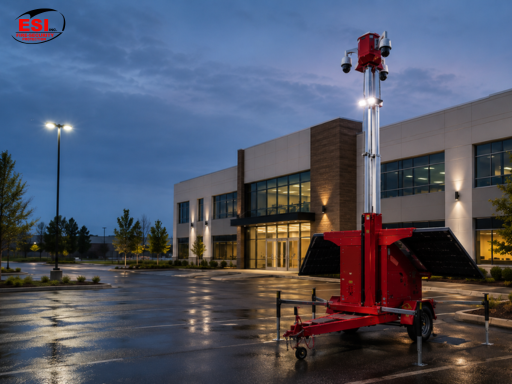
- Mobile Security Trailers for temporary or hard-to-cover areas
The goal is to identify suspicious activity as early as possible—ideally before an individual reaches the building or valuable assets.
8. Protect Vacant, Remote, and Temporary Areas
Vacant buildings, undeveloped sections of commercial properties, construction areas, overflow parking, and remote equipment locations can be difficult to secure with permanent systems.
These areas may be vulnerable to:
- Trespassing
- Illegal dumping
- Vandalism
- Copper theft
- Equipment theft
- Unauthorized occupancy
Mobile Security Trailers can provide rapidly deployable surveillance without requiring permanent infrastructure.
Depending on the application, they can provide elevated camera coverage, solar-powered operation, remote connectivity, AI analytics, and Proactive Video Monitoring.
They can also be relocated as security needs change.
9. Integrate Security Systems
One of the biggest opportunities for commercial properties is moving away from disconnected security technologies.
Instead of managing separate systems for cameras, doors, alarms, and monitoring, an integrated security approach can connect multiple technologies into a more coordinated strategy.
Integrated systems may include:
- Video surveillance
- Access control
- Intrusion detection
- Visitor management
- Proactive Video Monitoring
Integration can improve situational awareness, simplify system management, and provide security teams with more useful information when an incident occurs.
For organizations managing multiple buildings or locations, centralized security management can be especially valuable.
10. Review and Update Your Security Plan Regularly
Security should not be a one-time project.
Commercial properties change. Tenants move in and out, parking patterns shift, buildings expand, landscaping changes, and new vulnerabilities can develop.
Regular security reviews can help identify:
- Camera blind spots
- Outdated equipment
- Access permissions that need updating
- Poorly lit areas
- New high-risk zones
- Changes in property use
A security strategy should evolve with the property.
What Security Systems Does a Commercial Property Need?
There is no single system that is right for every property.
For many businesses, the strongest commercial property security systems use multiple layers of protection.
Video Surveillance
Provides visibility across entrances, parking areas, common spaces, and other critical locations while supporting investigations and incident documentation.
Access Control
Manages who can enter buildings and restricted areas while providing greater accountability than traditional keys.
Intrusion Detection
Helps detect unauthorized entry into buildings or protected areas, particularly after normal operating hours.
Proactive Video Monitoring
Adds real-time detection, verification, and intervention capabilities to video surveillance.
Mobile Security Trailers
Provide flexible coverage for large outdoor properties, vacant sites, construction areas, parking lots, and locations where permanent infrastructure may not be practical.
The right combination depends on the property’s size, layout, operating hours, occupancy, risks, and existing infrastructure.
Commercial Property Security for Different Types of Properties
Security requirements can vary significantly depending on how a property is used.
Office Buildings
Office properties may prioritize employee access, visitor management, parking security, and after-hours protection.
Retail Centers
Retail properties often need strong parking lot visibility, exterior surveillance, tenant security, and protection against theft and vandalism.
Industrial Properties
Industrial facilities may require perimeter protection, restricted-area access, equipment monitoring, and coverage across large outdoor areas.
Multi-Tenant Commercial Properties
Multi-tenant buildings need systems that can balance centralized property management with individual tenant access requirements.
Vacant Commercial Properties
Vacant properties can be particularly vulnerable to trespassing, vandalism, illegal dumping, and theft because there may be few people on-site to identify suspicious activity.
Understanding the property’s specific risks is critical when designing an effective solution.
Is Commercial Property Security Worth the Investment?
When evaluating security costs, it is important to consider more than the price of cameras, access control, or monitoring.
The potential cost of a security incident may include:
- Stolen property
- Vehicle damage
- Vandalism repairs
- Business interruption
- Insurance deductibles and claims
- Lost productivity
- Tenant concerns
- Liability exposure
Effective security can also provide benefits that are harder to measure directly, including improved visibility, better control over building access, faster incident response, and greater confidence for employees, tenants, and visitors.
The objective is not simply to respond after something happens. A strong security strategy is designed to reduce opportunities for incidents in the first place.
Choosing the Right Commercial Property Security Solution
The best solution starts with understanding the property.
A small office building does not have the same requirements as a large retail center, industrial complex, parking facility, or multi-property portfolio.
Consider:
- Property size and layout
- Number of entrances
- Parking and exterior areas
- Operating hours
- Tenant and employee activity
- Existing security systems
- Areas with valuable assets
- History of security incidents
- Future growth plans
From there, security technologies can be selected and integrated based on actual risks rather than using a one-size-fits-all approach.
Protecting Commercial Properties in Texas and Nationwide
Commercial properties in Texas often include large parking areas, expansive building footprints, outdoor equipment, and rapidly growing developments that can create unique security challenges.
From Houston and Southeast Texas to Dallas, Austin, San Antonio, and communities across the state, property owners and facility managers need security solutions capable of adapting to different environments and risks.
Headquartered in Texas and serving customers nationwide, ESI Fire & Security provides integrated security solutions for commercial properties of all sizes.
Whether you manage a single commercial building or multiple properties across different locations, ESI can help evaluate vulnerabilities and design a security strategy tailored to your needs.
Ready to strengthen security at your commercial property? Contact ESI Fire & Security today to schedule a security consultation and discuss the right solution for your property.
ESI Fire & Security Protection is one of three Honeywell Platinum dealers in Texas and is backed by over 25 years of industry experience. As leaders in the industry, we provide cutting-edge solutions for complete security and fire protection, including Mobile Security Trailers. Our team is dedicated to delivering top-tier solutions tailored to meet your needs, ensuring peace of mind for businesses across Texas and its surrounding regions. Contact us today to see how ESI Fire & Security can help enhance your perimeter security at your organization.
Frequently Asked Questions
Commercial property security includes the systems, technologies, and procedures used to protect commercial buildings, parking areas, employees, tenants, visitors, equipment, and other assets from theft, vandalism, trespassing, and unauthorized access. The best solution depends on the property, but many commercial buildings benefit from a combination of video surveillance, access control, intrusion detection, and Proactive Video Monitoring. Property managers can reduce risk by improving surveillance coverage, controlling building access, maintaining adequate lighting, monitoring parking and perimeter areas, and using proactive monitoring in higher-risk locations. Access control allows property managers to determine who can enter specific buildings or restricted areas, manage credentials, establish access schedules, and maintain records of access activity. Yes. Proactive Video Monitoring uses analytics and live monitoring specialists to identify suspicious activity and respond in real time, helping deter theft, vandalism, trespassing, and other unwanted activity. Yes. Mobile Security Trailers can provide flexible surveillance for parking lots, vacant properties, construction areas, equipment yards, and other locations where permanent security infrastructure may not be practical.