
AI Security Cameras: How Artificial Intelligence Is Changing Commercial Security
Traditional security cameras have long played an important role in protecting businesses. They provide visibility, record incidents, and give security teams valuable video evidence when something goes wrong.
But traditional cameras have one major limitation: someone still has to recognize that something important is happening.
AI security cameras are changing that.
Artificial intelligence and intelligent video analytics allow modern surveillance systems to analyze video and identify specific types of activity based on the capabilities and configuration of the system. Instead of relying solely on someone watching dozens of camera feeds, AI can help security teams focus their attention on events that may actually require a response.
For commercial properties, construction sites, warehouses, distribution centers, parking lots, industrial facilities, and other large environments, this can transform video surveillance from a primarily reactive tool into a much more proactive security resource.
What Are AI Security Cameras?
AI security cameras combine video surveillance with artificial intelligence or advanced video analytics.
Rather than treating every movement in a camera’s field of view the same way, compatible analytics can be configured to recognize and classify certain objects, behaviors, or events.
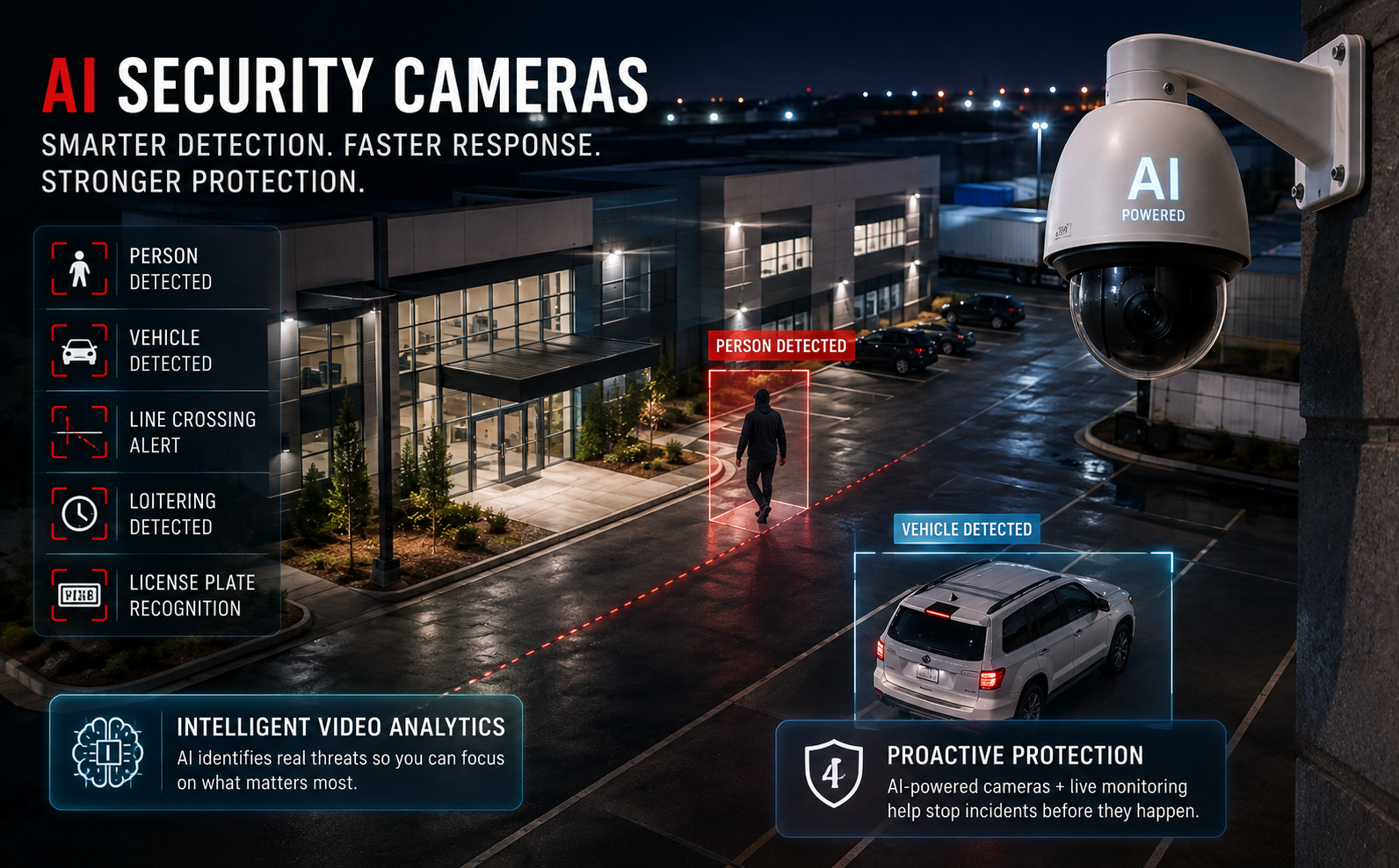
Depending on the technology being used, an AI video surveillance system may be capable of detecting or identifying events such as:
- People entering defined areas
- Vehicles
- Loitering
- Movement across virtual boundaries
- Activity during specified hours
- License plates
- Objects or other predefined conditions
The exact capabilities vary by camera, analytics platform, environment, and configuration.
The important difference is that the surveillance system is no longer limited to simply capturing video. It can help make that video more actionable.
10 Ways AI Security Cameras Are Changing Commercial Security
1. Detecting People and Vehicles More Intelligently
Traditional motion detection can generate alerts whenever something moves.
That can mean alerts caused by shadows, vegetation, weather, animals, or other irrelevant activity.
AI-powered analytics can provide more sophisticated object classification by distinguishing between categories such as people and vehicles.
For businesses, this can make alerts more meaningful.
For example, a person walking through a restricted equipment yard at 2:00 a.m. may deserve immediate attention. A tree moving in the wind does not.
Better classification helps security teams focus on events that matter.
2. Identifying Suspicious Activity in Real Time
One of the biggest advantages of AI security cameras is the ability to identify predefined activity as it occurs.
A system can potentially be configured to detect activity such as:
- A person entering a restricted zone
- Someone remaining in an area beyond a defined period
- After-hours activity
- A vehicle entering a protected area
- Movement across a virtual perimeter
Instead of discovering an incident the following morning, security personnel can potentially receive information while the activity is still occurring.
That difference is critical.
The sooner an event is detected, the more opportunity there is to respond.
3. Helping Reduce Unnecessary Alerts
Too many alarms can create a serious operational problem.
When security teams receive constant notifications that don’t require action, important events can become harder to identify.
Intelligent video analytics can help filter activity based on defined criteria rather than treating every movement as an equal threat.
For example, analytics might be configured to focus on a person entering a restricted area rather than every motion occurring within the camera view.
This can improve the usefulness of alerts and help operators concentrate on events that require closer attention.
4. Detecting Loitering and Unusual Activity
Not every security threat begins with someone breaking a window or forcing open a door.
Suspicious behavior often develops first.
Someone may remain near a closed business, repeatedly approach equipment, or spend an unusual amount of time in a restricted area.
Depending on the analytics platform, AI can help identify certain patterns such as loitering or prolonged presence within a defined zone.
This is particularly useful for:
- Parking lots
- Retail centers
- Equipment yards
- Construction sites
- Warehouses
- Commercial properties
Earlier awareness gives security teams an opportunity to investigate before activity escalates.
5. Strengthening Perimeter Security
A fence creates a boundary.
AI can help identify when that boundary is crossed.
Virtual lines and detection zones can be established within camera views to monitor important areas of a commercial property.
For example, a business may want alerts when a person crosses a fence line after hours or enters an outdoor equipment area.
When combined with physical barriers, lighting, access control, and monitoring, AI surveillance cameras can become an important part of a layered perimeter security strategy.
6. Making Video Search Faster
Finding an incident in traditional recorded video can be time-consuming.
If security personnel don’t know exactly when something occurred, they may need to review large amounts of footage.
Modern video analytics can make investigations more efficient by helping users search and filter recorded events based on supported criteria.
Instead of treating recorded video as one long timeline, intelligent search capabilities can help organizations locate relevant events more quickly.
That can be valuable when investigating:
- Theft
- Vandalism
- Vehicle incidents
- Unauthorized access
- Workplace incidents
- Property damage
AI doesn’t just help businesses identify activity in real time. It can also make recorded surveillance footage more useful after an event.
7. Improving Parking Lot Security
Parking lots can be challenging to monitor because they cover large areas and contain constant movement.
Employees, customers, visitors, delivery drivers, and vehicles may enter and exit throughout the day.
After hours, however, the same activity may indicate a potential security concern.
AI-powered video surveillance can help businesses monitor parking areas for predefined events and activity.
When appropriate for the application, technologies such as license plate recognition can provide additional vehicle information and support investigations or access management.
For commercial properties with large parking areas, combining intelligent cameras with Proactive Video Monitoring can provide an additional layer of protection.
8. Protecting Construction Sites and Outdoor Assets
Construction sites are constantly changing.
Equipment moves. Materials arrive. Temporary fencing changes. New structures are built.
This makes permanent surveillance infrastructure difficult in some environments.
AI-enabled cameras deployed through Mobile Security Trailers or other flexible surveillance solutions can help monitor equipment, materials, entrances, and perimeter areas.
Analytics can identify predefined activity while remote connectivity allows events and video to be reviewed without requiring someone to be physically present at the jobsite.
For remote or temporary locations, this provides contractors with greater visibility as security needs change throughout the project.
9. Supporting Proactive Video Monitoring
This is where AI can become especially powerful.
AI can detect an event.
But detection alone does not necessarily stop it.
When AI security cameras are combined with Proactive Video Monitoring, intelligent analytics can identify activity and bring relevant events to trained monitoring specialists for review.
If an event is verified and requires intervention, the response can follow predetermined protocols, which may include live audio warnings, customer notifications, or escalation when appropriate.
Consider the difference:
Traditional surveillance:
Incident occurs → Camera records it → Someone discovers it later → Footage is reviewed.
AI + Proactive Video Monitoring:
Activity occurs → AI identifies the event → Live operator reviews it → Appropriate intervention can begin.
That’s a significant shift from simply documenting incidents to helping address suspicious activity while it is occurring.
10. Creating Smarter Integrated Security Systems
AI cameras don’t have to operate independently.
Video surveillance can be integrated with other commercial security technologies, including:
- Access Control
- Intrusion Detection
- Visitor Management
- Proactive Video Monitoring
- Mobile Security Solutions
Imagine an access-controlled door opening after hours while the surveillance system simultaneously provides video of the event.
Instead of reviewing separate systems independently, integration can provide security personnel with better context.
The future of commercial security isn’t simply more cameras.
It’s smarter, connected security systems that provide better information and help people respond more effectively.
AI Security Cameras vs. Traditional Security Cameras
The difference between traditional cameras and AI-enabled surveillance is primarily what happens to the video after it is captured.
| Traditional Security Cameras | AI Security Cameras |
|---|---|
| Record video | Record and analyze video |
| Often rely on basic motion detection | Can use intelligent object classification |
| May require manual review | Can identify predefined events |
| Primarily reactive | Can support proactive security |
| Video searches may be time-consuming | Analytics can help accelerate investigations |
| Alerts may provide limited context | Intelligent alerts can provide more relevant information |
Traditional cameras still serve an important purpose. AI enhances surveillance by helping organizations identify meaningful activity within large amounts of video.
What Can AI Video Analytics Detect?
Capabilities vary depending on the analytics platform, cameras, and application.
Common technologies may include:
Person Detection
Identifies people entering or moving through monitored areas.
Vehicle Detection
Identifies vehicles within specified areas.
Loitering Detection
Can identify when a person remains within a defined area beyond a configured period.
Line Crossing
Creates a virtual boundary and identifies activity crossing that line.
Intrusion or Zone Detection
Monitors designated areas for people or vehicles during specified conditions.
License Plate Recognition
Captures and analyzes license plate information for supported applications.
The right analytics should be selected based on the actual security challenge rather than adding AI simply because the technology is available.
Which Businesses Can Benefit from AI Security Cameras?
AI video surveillance can be useful across many commercial environments.
Construction Sites
Monitor equipment, materials, perimeter areas, and after-hours activity.
Warehouses
Improve visibility around loading docks, entrances, inventory areas, and building perimeters.
Distribution Centers
Monitor high-traffic areas, trailers, loading zones, parking areas, and exterior property.
Commercial Properties
Improve surveillance around entrances, parking lots, common areas, and exterior spaces.
Manufacturing Facilities
Monitor restricted areas, outdoor equipment, entrances, and facility perimeters.
Retail Properties
Improve parking lot and exterior surveillance while supporting investigations.
Utilities and Critical Infrastructure
Monitor remote assets, restricted areas, and perimeter activity.
Schools and Campuses
Support surveillance across entrances, parking areas, exterior spaces, and other appropriate locations as part of a broader security plan.
Are AI Security Cameras Always Watching People?
It’s important to understand what AI surveillance actually does.
Most commercial video analytics are designed to identify predefined visual events or object classifications—not independently understand everything occurring at a property.
Organizations should carefully evaluate how surveillance technology is configured, where it is used, what information is collected, how long data is retained, and which users are authorized to access it.
Security technology should be deployed in accordance with applicable laws, organizational policies, and privacy requirements.
Do AI Security Cameras Replace Security Personnel?
Not necessarily.
AI is most effective when used to help people make faster and better-informed decisions.
Artificial intelligence can process large amounts of video and highlight potentially relevant activity. Human operators can then provide context, verification, judgment, and response.
This is especially important with Proactive Video Monitoring.
The goal isn’t simply:
AI instead of people.
A stronger model is:
AI detection + human verification + appropriate response.
How to Choose an AI Security Camera System
There is no single AI camera solution that is right for every business.
Before selecting technology, consider:
- Property size
- Camera coverage requirements
- Indoor vs. outdoor environments
- Lighting conditions
- Existing surveillance infrastructure
- Security risks
- Required analytics
- Remote viewing needs
- Monitoring requirements
- Integration with existing systems
- Video storage requirements
Businesses should begin by identifying the problem they are trying to solve.
For example, a construction company trying to detect after-hours trespassing has very different needs from a warehouse trying to improve loading dock visibility.
The technology should support the security objective—not the other way around.
AI Security Cameras Are Changing Security from Reactive to Proactive
For decades, the primary purpose of security cameras was to answer one question:
What happened?
Artificial intelligence allows businesses to begin asking another:
What’s happening right now?
That’s an important evolution.
AI-powered analytics can help organizations identify activity sooner, search video more efficiently, improve perimeter awareness, and direct attention toward events that may require action.
When intelligent video analytics are combined with live monitoring and an appropriate response strategy, video surveillance can become much more than a recording system.
It can become an active part of a comprehensive security program.
Smarter Commercial Security with ESI
Headquartered in Texas and serving customers nationwide, ESI Fire & Security provides advanced video surveillance and integrated security solutions designed around each customer’s specific environment and requirements.
ESI can provide flexible analytics options based on the application, including technologies such as Cvedia AI, Spot AI, License Plate Recognition (LPR), LiDAR technology, and other specialized analytics.
Depending on the customer’s needs, video solutions can be configured with platforms such as NX Witness with Cvedia Analytics, Spot AI and its suite of AI capabilities, or securely integrated with a customer’s existing video management environment.
Our security solutions include:
- AI Video Surveillance
- Proactive Video Monitoring
- Mobile Security Trailers
- Access Control
- Intrusion Detection
- Integrated Security Systems
The right AI security solution isn’t about choosing the technology with the longest list of features. It’s about selecting the right analytics, cameras, monitoring, and response strategy for the property you’re protecting.
Want to explore how AI security cameras could improve security at your facility? Contact ESI Fire & Security to discuss your property, current security challenges, and available video analytics solutions.
ESI Fire & Security Protection is one of three Honeywell Platinum dealers in Texas and is backed by over 25 years of industry experience. As leaders in the industry, we provide we provide cutting-edge commercial security solutions, including Mobile Security Trailers, Proactive Video Monitoring, Video Surveillance, Access Control, and Intrusion Detection. Our team is dedicated to delivering top-tier solutions tailored to meet your needs, ensuring peace of mind for businesses across Texas and nation wide. Contact us today to see how ESI Fire & Security can help enhance your perimeter security at your organization.
Frequently Asked Questions
AI security cameras combine video surveillance with artificial intelligence or advanced video analytics to help identify specific objects, activity, or events within camera footage.
Traditional cameras primarily record video for live viewing or later review. AI-enabled cameras and video analytics can also classify objects, identify predefined events, and generate more intelligent alerts.
Depending on the system, AI analytics may detect people, vehicles, loitering, line crossing, activity within defined zones, license plates, and other predefined events.
AI security cameras can help identify suspicious activity sooner. When combined with Proactive Video Monitoring or another response strategy, this can allow intervention while an event is occurring rather than relying solely on recorded evidence afterward.
Intelligent analytics can help reduce unnecessary alerts by distinguishing between different types of activity and focusing on predefined events. Performance depends on the system, environment, configuration, and application.
Many commercial cameras are designed for low-light or nighttime surveillance, but performance depends on the camera, lighting, infrared capabilities, analytics, and site conditions.
Depending on the equipment and platform, AI video surveillance can often be integrated with existing video management systems and other technologies such as access control, intrusion detection, and monitoring solutions.
AI video surveillance is used across construction, logistics, warehousing, manufacturing, retail, commercial real estate, utilities, transportation, education, and other commercial environments.