Remote Site Security: How to Protect Properties Without Power or Internet
How do you protect a property when there is no electricity, internet connection, or permanent building to install security equipment?
It’s a common problem for construction companies, utilities, energy companies, contractors, municipalities, agricultural operations, and businesses managing remote properties.
A traditional security camera system typically depends on infrastructure. Cameras need power. Video needs to be transmitted or recorded. Monitoring requires connectivity.
But many high-value assets are located exactly where that infrastructure doesn’t exist.
Fortunately, remote site security no longer has to depend entirely on permanent power and hardwired internet connections.
Solar power, battery storage, cellular connectivity, intelligent video analytics, and remote monitoring have changed what’s possible.
Here’s how businesses can protect remote properties—and what to consider when designing a security system for a location without traditional infrastructure.
Why Are Remote Sites Difficult to Secure?
A remote property can present a completely different security challenge than a warehouse, office, or occupied commercial building.
There may be:
- No permanent electricity
- No wired internet
- Limited personnel
- Large distances between assets
- Few nearby witnesses
- Limited lighting
- Multiple access points
- Valuable equipment stored outdoors
- Changing site conditions
- Long periods with no employees present
These conditions can make remote locations attractive targets for trespassing, theft, vandalism, dumping, and unauthorized activity.
The problem isn’t necessarily that the site has no security equipment.
It’s that traditional security infrastructure may not be practical there.
Running electrical service, installing network infrastructure, trenching cable, building camera poles, and establishing permanent communications can become expensive—especially for a site that may only exist temporarily.
That’s where purpose-built remote security technology becomes valuable.
Can Security Cameras Work Without Electricity?
Yes.
A security camera doesn’t necessarily need to be connected to the property’s electrical grid.
One solution is solar-powered surveillance.
Solar panels generate energy during daylight hours, while batteries store energy to support operation when solar production is unavailable.
The system must be properly designed around factors such as:
- Camera power requirements
- Solar panel capacity
- Battery capacity
- Expected operating time
- Local weather
- Seasonal sunlight
- Additional equipment drawing power
This is important because putting a small solar panel on a camera doesn’t automatically make it a reliable off-grid security system.
A professionally designed system needs enough generation and battery capacity to support the complete security solution.
Can Security Cameras Work Without Wi-Fi?
They can.
Wi-Fi is only one method of connecting a surveillance system.
For remote properties without traditional internet service, cellular connectivity can provide another path for transmitting video and security events.
Depending on the site and equipment, other connectivity options may also be available.
This allows remote surveillance systems to communicate without relying on the property’s existing internet connection.
The result is significant:
No Wi-Fi does not automatically mean no remote monitoring.
That opens the door to protecting properties that historically would have been difficult or expensive to monitor.
10 Ways to Improve Remote Site Security
1. Start With a Remote Site Security Assessment
Before installing equipment, determine exactly what you’re trying to protect.
CISA’s physical-security guidance recommends a layered approach rather than depending on one security measure, and its Security Planning Workbook divides protection into outer, middle, and inner perimeters.
For a remote site, identify:
- Primary entrances
- Vehicle access points
- Property boundaries
- High-value equipment
- Material storage
- Fuel storage
- Buildings or temporary structures
- Areas hidden from surrounding roads
- Likely approaches to the property
- Existing power and communications infrastructure
Not every acre necessarily requires the same level of protection.
The goal is to identify the areas where detection would provide the greatest security value.
2. Use Solar Power Where Grid Power Isn’t Available
Remote security technology needs a dependable power source.
Solar power can eliminate the need to extend permanent electrical service to some surveillance locations.
For temporary or isolated sites, this can significantly expand where cameras can be deployed.
A properly configured system can combine:
Solar generation → battery storage → surveillance equipment → communications equipment
This makes remote security possible in areas such as:
- Construction sites
- Utility projects
- Oil & gas sites
- Solar farms
- Equipment storage
- Agricultural properties
- Vacant land
- Infrastructure projects
Solar power is particularly useful when the security need may move as the project changes.
3. Use Cellular or Alternative Connectivity
Power solves only half of the problem.
If the system needs to communicate with users or a monitoring center, it also needs connectivity.
Cellular communication can provide remote connectivity without requiring wired broadband at the property.
Depending on the application and available technology, other connectivity options may also be appropriate.
When evaluating a remote site, it’s important to consider connectivity early rather than assuming traditional internet service must be installed first.
4. Deploy Mobile Security Trailers
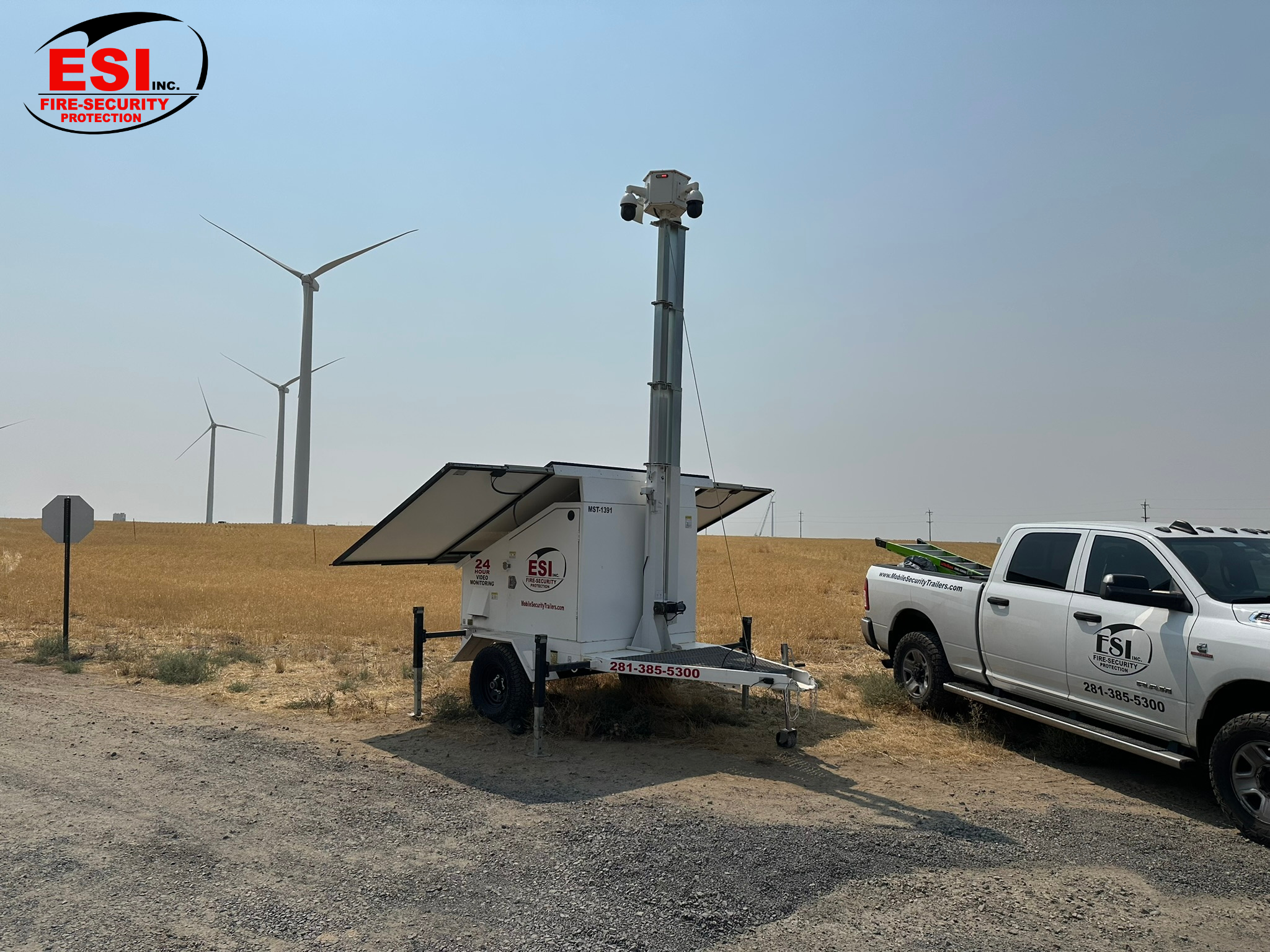
One of the most practical solutions for large, temporary, or changing remote properties is a Mobile Security Trailer.
Instead of constructing permanent security infrastructure, the surveillance platform can be brought directly to the location.
Depending on its configuration, a Mobile Security Trailer can provide:
- Solar power
- Battery backup
- Remote connectivity
- Elevated cameras
- PTZ surveillance
- Infrared capability
- AI video analytics
- Recorded video
- Proactive Video Monitoring
- Live audio intervention
ESI’s Mobile Security Trailers can be configured with 1–4 cameras, allowing the system to be designed around the property’s coverage requirements.
Another advantage is mobility.
If equipment moves from one side of a project to another, the surveillance system can be repositioned.
That is especially valuable on construction and infrastructure projects where the security footprint constantly changes.
5. Use Elevated Cameras to Increase Coverage
Remote sites can be large.
Installing numerous cameras at ground level isn’t always the most efficient approach.
Elevated surveillance can provide a wider field of view and help monitor:
- Property entrances
- Fence lines
- Equipment
- Material storage
- Parking areas
- Open land
- Multiple sections of a project
Elevation can also help reduce problems caused by equipment, trailers, containers, and other objects blocking camera views.
For large properties, camera height can be just as important as camera quantity.
6. Add AI Video Analytics
The challenge with remote surveillance isn’t simply capturing video.
It’s identifying activity that matters.
A camera can record an empty property for hundreds of hours. Someone eventually has to find the few minutes that matter.
AI-powered video analytics can help identify predefined events involving people, vehicles, or activity within monitored areas.
Depending on the platform and configuration, analytics may identify:
- People entering restricted areas
- Vehicles entering the property
- Line crossings
- Loitering
- After-hours movement
- Activity within defined zones
This allows a remote security system to focus attention on relevant events rather than simply collecting footage.
7. Use Proactive Video Monitoring
There is a major difference between recording an incident and responding while it is occurring.
Traditional surveillance often works like this:
Trespasser enters → Camera records activity → Incident occurs → Someone discovers it later → Video is reviewed.
Proactive Video Monitoring changes that process.
Activity detected → Event presented for review → Monitoring specialist verifies activity → Response protocol begins.
Depending on the circumstances and established procedures, response may include:
- Live audio warnings
- Customer notification
- Escalation
- Law enforcement notification when appropriate
For remote sites, this is particularly valuable because there may be no employee nearby to notice suspicious activity.
A camera provides visibility.
Monitoring helps turn that visibility into action.
8. Protect the Assets, Not Just the Property Line
A remote property may cover dozens—or hundreds—of acres.
Trying to create identical surveillance coverage across every square foot may not be the best use of the security budget.
Instead, consider concentrating protection around critical assets.
CISA guidance similarly notes that, depending on the size and location of critical assets, focusing protection on individual assets can sometimes be more cost-effective than securing an entire perimeter.
Priority areas might include:
- Heavy equipment
- Fuel tanks
- Copper
- Generators
- Transformers
- Trailers
- Tools
- Materials
- Temporary buildings
- Critical infrastructure
This creates a security zone around the assets that would cause the greatest financial or operational loss.
9. Combine Physical & Electronic Security
Technology shouldn’t replace basic physical security.
Remote sites can benefit from combining electronic security with:
- Fencing
- Gates
- Locks
- Barriers
- Lighting
- Equipment immobilization
- GPS tracking
- Signage
- Controlled access
CISA guidance emphasizes this type of layered security, combining physical barriers, electronic security systems, detection, and response rather than relying on a single measure.
Consider the layers:
Deter → Detect → Verify → Respond → Investigate
A fence may deter or delay entry.
A camera provides visibility.
Analytics can detect configured activity.
Monitoring can verify what is happening.
A response plan determines what happens next.
Each layer supports the others.
10. Reevaluate Security as the Site Changes
Remote sites are rarely static.
Construction progresses.
Equipment moves.
Materials arrive and leave.
New access roads open.
Temporary buildings appear.
Vegetation grows.
A camera that provided excellent coverage three months ago may now be blocked by equipment or pointed toward an area that is no longer high risk.
Regularly ask:
- Are we still monitoring our highest-value assets?
- Have new blind spots developed?
- Have equipment or materials moved?
- Has the site’s perimeter changed?
- Are access points different?
- Has connectivity changed?
- Does the surveillance equipment need to be repositioned?
This is another advantage of mobile security equipment: security can move as the risk moves.
What Types of Remote Sites Need Security?
Remote security systems can be useful anywhere valuable assets are located away from permanent infrastructure.
Construction Sites
Construction projects frequently lack permanent power and internet during early phases.
At the same time, contractors may have expensive equipment, tools, copper, materials, generators, and fuel sitting on-site.
Utility & Substation Sites
Utilities often operate critical assets in remote or lightly staffed locations.
Remote surveillance can provide visibility around gates, equipment, perimeter areas, and critical infrastructure.
Oil & Gas Sites
Oilfield and energy operations can span large geographic areas where traditional security infrastructure isn’t practical.
Solar Farms
Solar facilities may cover large areas in remote locations, creating challenges involving perimeter protection, equipment, and critical electrical infrastructure.
Equipment Yards
Temporary or remote equipment storage areas can contain high-value machinery without a permanent building or on-site security personnel.
Agriculture
Farms, ranches, agricultural equipment storage, and remote facilities may benefit from surveillance where conventional internet infrastructure is limited.
Vacant Properties & Land
Properties awaiting construction, redevelopment, sale, or occupancy can remain unattended for long periods.
Infrastructure Projects
Road, pipeline, utility, rail, and other infrastructure projects may constantly shift geographically, making permanent surveillance infrastructure impractical.
Remote Security Cameras vs. Mobile Security Trailers
Not every remote property requires the same solution.
A standalone solar-powered camera may work well when:
- The monitoring area is relatively small
- One or two views are sufficient
- Equipment can be securely mounted
- Power requirements are limited
- The security need is relatively static
A Mobile Security Trailer may be more appropriate when:
- The property is large
- Elevated coverage is needed
- Multiple cameras are required
- The site changes frequently
- Security needs to be relocated
- Proactive monitoring is desired
- There is no suitable permanent mounting structure
The correct choice depends on the site’s size, assets, risks, available infrastructure, and desired response.
What Happens When Cellular Coverage Is Weak?
This is an important question—and one businesses should ask before deploying a remote surveillance system.
Not every remote location has strong cellular service.
Connectivity should therefore be evaluated during the design process.
Depending on the property and system, potential solutions may include different cellular carriers, antennas, alternative communications technologies, or other available connectivity options.
The key is not to assume.
A remote security solution should be designed around the actual conditions at the property, including power availability, cellular coverage, terrain, camera distances, and environmental conditions.
Can You Monitor a Remote Property From Anywhere?
When connectivity and system configuration support remote access, authorized users may be able to view cameras and security information without physically traveling to the property.
That can be valuable for organizations managing multiple remote locations.
Instead of driving to a site simply to determine whether something is happening, personnel may have greater situational awareness remotely.
However, remote-access security matters too. For industrial and critical-infrastructure environments, CISA recommends minimizing unnecessary internet exposure, restricting access and using secure methods when remote access is required.
Physical security shouldn’t introduce unnecessary cybersecurity risk.
Choosing a Remote Site Security System
Before selecting a solution, ask these questions:
- What assets are we protecting?
- What would cause the greatest operational loss?
- Is permanent electricity available?
- Is wired internet available?
- What cellular coverage exists?
- How large is the property?
- Where are the primary access points?
- Do we need cameras to record or actively monitor?
- Will the security footprint change?
- Do we need the ability to relocate the system?
- What happens when suspicious activity is detected?
- Who is responsible for responding?
The final question is especially important.
Detection without a response plan is incomplete security.
Remote Site Security in Texas & Nationwide
Remote properties are common throughout Texas.
Construction projects, utilities, energy infrastructure, equipment yards, industrial properties, agricultural operations, and development sites can be located miles from traditional infrastructure.
But remote security challenges aren’t limited to Texas.
Headquartered in Texas and serving customers nationwide, ESI Fire & Security provides scalable security solutions for organizations that need to protect assets in challenging environments.
Solutions can include:
- Video Surveillance
- AI Video Analytics
- Proactive Video Monitoring
- Mobile Security Trailers
- Access Control
- Intrusion Detection
- Integrated Security Systems
- Solar-Powered Security
The right combination depends on the property.
No Power. No Internet. That Doesn’t Have to Mean No Security.
Remote properties used to present a difficult choice: invest heavily in permanent infrastructure, hire on-site personnel, or accept limited visibility.
Technology has changed that equation.
Solar power can address the electricity problem.
Cellular and alternative connectivity can address the communications problem.
AI analytics can help identify relevant activity.
Proactive Video Monitoring can provide human verification.
Mobile Security Trailers can bring these technologies together in a system that can be deployed where security is needed.
The result is a different approach to remote site security—one designed around the property instead of requiring the property to be built around the security system.
Have a remote property without reliable power or internet? Contact ESI Fire & Security to discuss your site, available infrastructure, coverage requirements, and the right remote security solution for your operation.
ESI Fire & Security Protection is one of three Honeywell Platinum dealers in Texas and is backed by over 25 years of industry experience. As leaders in the industry, we provide cutting-edge commercial security solutions, including Mobile Security Trailers, Proactive Video Monitoring, Video Surveillance, Access Control, and Intrusion Detection. Our team is dedicated to delivering top-tier solutions tailored to meet your needs, ensuring peace of mind for businesses across Texas and nation wide. Contact ESI Fire & Security today to learn how our Mobile Security Trailers and Proactive Video Monitoring solutions can help improve jobsite security and prevent costly theft and vandalism.
Frequently Asked Questions
Yes. Depending on the system and location, cellular or other communications technologies can provide connectivity without relying on traditional Wi-Fi or wired internet service.
The best solution depends on the property’s size, available power, connectivity, assets, and risks. Options may include solar-powered cameras, Mobile Security Trailers, cellular connectivity, AI video analytics, intrusion detection, and Proactive Video Monitoring.
A Mobile Security Trailer is a relocatable surveillance platform that can combine cameras, solar power, battery storage, remote connectivity, analytics, recording, and monitoring for locations where permanent security infrastructure may be unavailable or impractical.
Yes, when adequate connectivity is available. Remote video systems can transmit events for live or proactive monitoring, depending on the system configuration and service.
Connectivity should be evaluated before deployment. Depending on the location and system, different carriers, antennas, or alternative connectivity options may be considered.
Common applications include construction sites, utility facilities, substations, oil and gas sites, solar farms, equipment yards, agricultural properties, vacant properties, infrastructure projects, and other remote commercial locations.