

Equipment Yard Security: How to Prevent Theft, Trespassing & Equipment Loss
Heavy equipment, trailers, tools, vehicles, fuel, and materials can represent hundreds of thousands—or even millions—of dollars in assets sitting outdoors.
For contractors, equipment rental companies, utilities, industrial facilities, trucking operations, and other businesses, protecting those assets presents a unique challenge. Equipment yards are often large, outdoors, lightly staffed after hours, and filled with valuable assets that can be difficult to monitor.
A fence and locked gate may slow someone down, but they don’t tell you when a person has entered the property or is approaching a piece of equipment.
Effective equipment yard security requires multiple layers of protection designed to deter unauthorized activity, detect potential threats, control access, and provide a way to respond when suspicious activity occurs.
Here are 10 ways businesses can strengthen equipment yard security and better protect valuable assets.
Why Are Equipment Yards Targets for Theft?
Equipment yards can create an attractive opportunity for thieves because valuable assets are often stored outdoors and may remain unattended overnight, on weekends, or for extended periods.
Depending on the operation, an equipment yard may contain:
- Excavators
- Skid steers
- Loaders
- Tractors
- Generators
- Trailers
- Trucks
- Construction equipment
- Power tools
- Copper and other materials
- Fuel
- Batteries
- Attachments and accessories
And equipment theft isn’t always as obvious as someone stealing a large machine.
Fuel can disappear. Batteries can be removed. Tools can be taken from vehicles. Catalytic converters can be stolen. Trailers can be hooked up and driven away. Equipment attachments and materials can disappear without an entire machine ever leaving the property.
That’s why equipment theft prevention should address the entire yard—not just the largest pieces of equipment.
10 Ways to Improve Equipment Yard Security
1. Start with a Secure Perimeter
Fencing is still an important first layer of equipment yard security.
A well-maintained perimeter creates a defined boundary and makes unauthorized access more difficult.
Inspect the property for:
- Damaged fencing
- Gaps beneath fences
- Unsecured gates
- Areas hidden by vegetation
- Locations where equipment could be used to climb a fence
- Remote sections of the property
- Unprotected vehicle access points
But remember: a fence is a barrier, not a complete security system.
If someone climbs or cuts through a fence at 2:00 a.m., you need a way to know it’s happening.
That’s where surveillance and proactive monitoring become important.
2. Use Video Surveillance Throughout the Yard
Strategically placed cameras can provide visibility across areas that employees cannot continuously monitor.
Equipment yard cameras should be positioned around high-risk locations such as:
- Gates
- Fence lines
- Equipment storage areas
- Fuel tanks
- Vehicle entrances
- Tool storage
- Loading areas
- Parking areas
- Remote sections of the property
Elevated cameras can be particularly valuable because equipment itself can create blind spots.
A camera mounted too low may have a clear view one day and be completely blocked by an excavator or trailer the next.
Camera placement should account for the way equipment moves throughout the property.
3. Add AI Video Analytics
Modern surveillance systems can do more than simply record video.
AI-powered video analytics can help identify predefined activity such as people or vehicles entering monitored areas.
Depending on the system and configuration, analytics may be used to identify:
- People entering restricted zones
- Vehicles entering the property
- After-hours activity
- Loitering
- Movement across virtual boundaries
- Other predefined events
This helps turn cameras from passive recording devices into more intelligent security tools.
Instead of expecting someone to continuously watch every camera, analytics can help direct attention toward events that may require review.
4. Use Proactive Video Monitoring
Recording someone stealing a $75,000 piece of equipment may help an investigation.
Stopping the activity before the equipment leaves the yard is the bigger objective.
Proactive Video Monitoring combines surveillance technology and analytics with trained monitoring specialists who can evaluate suspicious activity in real time.
When an event is detected, a live operator can review what is happening and follow established response protocols.
Depending on the situation, that may include:
- Live audio intervention
- Customer notification
- Escalation of verified suspicious activity
- Law enforcement notification when appropriate
This changes the role of video surveillance.
Traditional surveillance:
Activity occurs → Camera records it → Theft occurs → Someone discovers it later → Video is reviewed.
Proactive monitoring:
Activity occurs → System detects it → Operator verifies it → Intervention can begin while the person is still on-site.
For an unattended equipment yard, that difference can be significant.
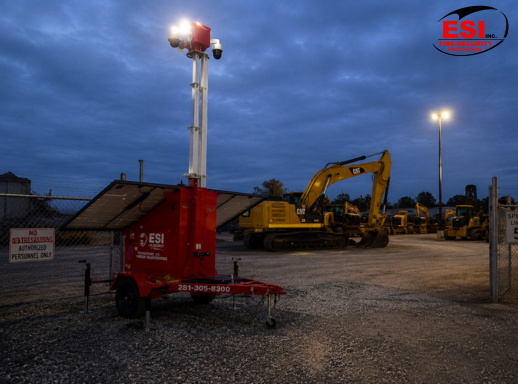
5. Deploy Mobile Security Trailers
Large equipment yards can be difficult to cover with permanent cameras.
Power and internet may not be available in the areas where cameras are needed most. Installing poles, trenching cable, and adding permanent infrastructure can also be expensive or impractical.
Mobile Security Trailers provide another option.
Depending on the configuration, a Mobile Security Trailer can provide:
- Elevated surveillance
- 1–4 camera configurations
- Solar power
- Battery backup
- Remote connectivity
- AI-powered analytics
- Proactive Video Monitoring
- Live audio intervention
- Recorded video
Because the system is mobile, coverage can also be repositioned as the yard changes.
If valuable equipment moves from one area of the property to another, surveillance can move with it.
That flexibility makes Mobile Security Trailers particularly useful for equipment yards, construction staging areas, temporary storage sites, and remote facilities.
6. Control Vehicle and Gate Access
The gate is one of the most important security points in an equipment yard.
Businesses should know:
- Who entered
- When they entered
- Why they entered
- Which vehicle entered
- When they left
Depending on the operation, gate security may include:
- Access control
- Employee credentials
- Vehicle gates
- Intercoms
- Video surveillance
- License plate recognition
- Visitor management
The objective is to reduce uncontrolled access while maintaining efficient operations.
A gate that remains open all day can undermine the security provided by the fence surrounding it.
7. Improve Lighting
Dark areas make it easier for unauthorized individuals to approach equipment without being noticed.
Lighting should be evaluated around:
- Gates
- Fence lines
- Equipment storage
- Fuel areas
- Buildings
- Parking areas
- Loading areas
- Remote corners of the yard
Lighting also supports video surveillance by improving image quality in certain environments.
However, lighting should complement surveillance—not replace it.
A brightly lit equipment yard can still be vulnerable if nobody knows an unauthorized person is there.
8. Secure Equipment Individually
Site security should be combined with measures that make individual pieces of equipment more difficult to steal or operate.
Depending on the asset and manufacturer, this may include:
- Immobilizers
- GPS tracking
- Telematics
- Locking devices
- Key management
- Battery disconnects
- Equipment identification
- Secure storage for keys
Keys should never be left inside equipment simply because the yard is fenced.
The more layers a thief has to defeat, the more difficult and time-consuming the theft becomes.
9. Protect Fuel, Tools & Smaller Assets
Heavy equipment may receive the most attention, but smaller assets are often easier targets.
Businesses should also secure:
- Fuel tanks
- Batteries
- Tools
- Generators
- Copper
- Equipment attachments
- Catalytic converters
- Building materials
High-value areas should be positioned within surveillance coverage whenever possible.
Inventory procedures can also help identify missing assets sooner instead of discovering losses days or weeks later.
10. Review Security as the Yard Changes
Equipment yards are dynamic environments.
Inventory changes. Equipment moves. New trailers arrive. Temporary storage areas are created. Vegetation grows. Cameras can become obstructed.
Security should therefore be reviewed regularly.
Ask:
- Are cameras still covering our highest-value assets?
- Have new blind spots developed?
- Is the perimeter intact?
- Are gates functioning correctly?
- Are lights working?
- Has equipment placement blocked camera views?
- Are employee access credentials current?
- Have theft patterns or security risks changed?
An effective equipment yard security system should adapt as the operation changes.
How to Secure an Equipment Yard Without Power or Internet
Some of the hardest equipment yards to protect are remote locations with little or no permanent infrastructure.
You may have valuable equipment sitting on acres of property without readily available electricity, wired internet, or buildings suitable for mounting cameras.
That doesn’t mean the site has to remain unmonitored.
Solar-powered Mobile Security Trailers can operate independently of traditional electrical infrastructure. Battery systems support continued operation, while cellular or other available connectivity options can support remote monitoring.
This allows businesses to establish surveillance in locations where installing a conventional permanent system may be difficult.
It can be especially useful for:
- Remote equipment yards
- Construction staging areas
- Utility projects
- Temporary storage yards
- Industrial properties
- New developments
- Large outdoor facilities
Instead of waiting for permanent infrastructure, security can be deployed where assets are located.
Equipment Yard Security Cameras: Where Should They Be Installed?
Camera placement can make the difference between useful surveillance and video that doesn’t capture what you need.
Priority areas should typically include:
Entrances & Exits
Capture people and vehicles entering and leaving the property.
Gates
Monitor access activity and provide visual verification of events.
Fence Lines
Watch vulnerable perimeter areas where unauthorized access may occur.
Equipment Storage
Provide coverage of high-value machinery and vehicles.
Fuel Storage
Monitor an area that can be particularly vulnerable to theft.
Tool & Material Storage
Protect smaller assets that may be easier to remove.
Remote Corners
Reduce blind spots and improve overall site awareness.
A professional security assessment can help determine camera type, mounting height, viewing angle, analytics, lighting requirements, and coverage based on the actual property.
Equipment Yard Security vs. Security Guards
Some businesses use security guards to patrol outdoor equipment yards.
Guards can be useful in applications requiring physical gate control, employee interaction, visitor assistance, or on-site response.
However, large equipment yards can present challenges for traditional patrols.
One person cannot physically observe every section of a large property at the same time.
Video surveillance and proactive monitoring can provide visibility across multiple areas simultaneously while maintaining recorded evidence of events.
For some properties, technology may reduce the need for continuous physical patrols. For others, the strongest approach may combine guards with surveillance, access control, and monitoring.
The right solution depends on the site and its risks.
Who Needs Equipment Yard Security?
Equipment yard security isn’t limited to construction companies.
Businesses and organizations that may benefit include:
- Heavy equipment contractors
- Equipment rental companies
- Construction companies
- Utilities
- Oil & gas operations
- Municipalities
- Transportation companies
- Trucking companies
- Logistics facilities
- Manufacturing companies
- Industrial facilities
- Rail operations
- Landscaping companies
- Agricultural operations
- Auto and equipment dealerships
Any organization storing valuable assets outdoors should consider how those assets are protected after employees leave.
What Does Equipment Theft Really Cost?
The cost of equipment theft extends beyond the replacement value of the stolen asset.
A stolen machine can also result in:
- Project delays
- Equipment rental expenses
- Lost productivity
- Employee downtime
- Insurance claims
- Deductibles
- Increased administrative work
- Missed deadlines
- Customer disruptions
A missing excavator doesn’t just mean replacing an excavator.
If crews cannot work because critical equipment is gone, the operational cost can continue until a replacement is available.
This is why equipment security should be evaluated as part of operational risk management—not simply as another property expense.
A Layered Approach to Heavy Equipment Theft Prevention
There is no single product that can eliminate every security risk.
The strongest heavy equipment security strategy uses multiple layers.
Layer 1: Deter
Use fencing, lighting, signage, cameras, and visible security equipment to make the property a less attractive target.
Layer 2: Detect
Use surveillance, AI analytics, intrusion detection, and access control to identify unauthorized activity.
Layer 3: Verify
Use video and live monitoring to determine whether activity represents a legitimate security concern.
Layer 4: Respond
Follow established protocols that may include live audio intervention, customer notifications, or law enforcement notification when appropriate.
Layer 5: Investigate
Maintain recorded video, access records, and other information that can support investigations when an incident occurs.
Each layer makes the overall security strategy stronger.
Equipment Yard Security in Texas & Nationwide
Texas businesses often manage large properties, outdoor equipment, remote jobsites, industrial operations, and rapidly changing work environments.
From Houston, Baytown, Beaumont, Pasadena, Deer Park, La Porte, League City, and The Woodlands to Dallas, Austin, San Antonio, and locations throughout Texas, businesses need security solutions that can adapt to large outdoor environments.
But equipment theft isn’t limited to Texas.
Headquartered in Texas and serving customers nationwide, ESI Fire & Security provides scalable security solutions for equipment yards and commercial properties across the country.
Our solutions include:
- Video Surveillance
- AI Video Analytics
- Proactive Video Monitoring
- Mobile Security Trailers
- Access Control
- Intrusion Detection
- Integrated Security Systems
Whether you’re protecting a small contractor yard or a large industrial equipment facility, the right security strategy begins with understanding where your vulnerabilities are and how quickly you need to know when something goes wrong.
Protect Your Equipment Before It Leaves the Yard
A locked gate and fence are important, but they shouldn’t be the only things standing between a thief and your most valuable equipment.
Effective equipment yard security combines physical barriers with visibility, intelligent detection, controlled access, monitoring, and a response plan.
The goal isn’t simply to have video showing what happened after a machine disappears.
It’s to identify suspicious activity earlier and create opportunities to intervene before valuable equipment leaves the property.
Need to improve security at your equipment yard? Contact ESI Fire & Security to discuss your property, equipment, existing security systems, and the right combination of surveillance, monitoring, and security technology for your operation.
ESI Fire & Security Protection is one of three Honeywell Platinum dealers in Texas and is backed by over 25 years of industry experience. As leaders in the industry, we provide cutting-edge commercial security solutions, including Mobile Security Trailers, Proactive Video Monitoring, Video Surveillance, Access Control, and Intrusion Detection. Our team is dedicated to delivering top-tier solutions tailored to meet your needs, ensuring peace of mind for businesses across Texas and nation wide. Contact ESI Fire & Security today to learn how our Mobile Security Trailers and Proactive Video Monitoring solutions can help improve jobsite security and prevent costly theft and vandalism.
Frequently Asked Questions
A layered approach may include perimeter fencing, controlled gates, video surveillance, Proactive Video Monitoring, lighting, equipment tracking, individual equipment security, and Mobile Security Trailers.
The right cameras depend on yard size, lighting, viewing distances, asset locations, and security risks. Commercial systems may use fixed cameras, PTZ cameras, infrared capabilities, AI analytics, and elevated cameras to cover large outdoor areas.
Yes. Mobile Security Trailers are well suited for equipment yards because they can provide elevated surveillance, solar-powered operation, remote connectivity, AI analytics, and proactive monitoring without requiring permanent infrastructure.
Solar-powered Mobile Security Trailers can provide surveillance without relying on existing electrical infrastructure. Battery backup and cellular or other available connectivity options can support remote monitoring at remote sites.
Proactive Video Monitoring combines surveillance and analytics with trained monitoring specialists who evaluate suspicious activity in real time. Verified events can trigger live audio intervention, customer notifications, or other predetermined response procedures.
Priority areas typically include entrances, exits, gates, fence lines, equipment storage areas, fuel tanks, tool storage, loading areas, and remote sections of the property.